4.9 Star Rating 250+ Reviews

4.9 Star Rating 250+ Reviews
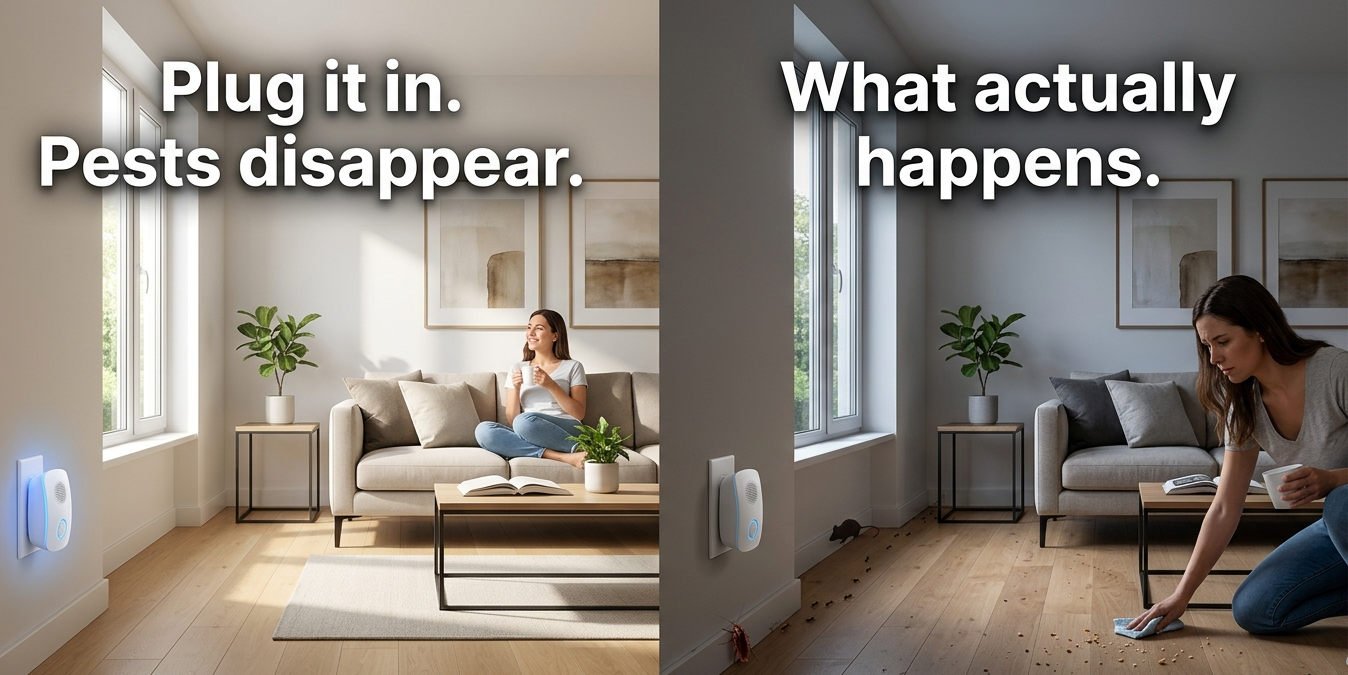
Ultrasonic insect repellers are widely marketed as a simple, chemical-free way to keep pests out of your home. These plug-in devices claim to use high-frequency sound waves to drive away insects and rodents without traps, sprays, or ongoing maintenance.
It is an appealing solution, especially for homeowners looking for a low-effort, eco-conscious option. But the key question remains: does ultrasonic pest control actually work?
The short answer is no, not reliably. Despite widespread availability and strong marketing claims, scientific research and regulatory findings have consistently shown that ultrasonic devices have little to no lasting effect on common household pests.
To understand why, it helps to look at how these devices are supposed to work, what studies have found, and what truly protects your home from persistent infestations.
Ultrasonic pest repellers are plug-in electronic devices designed to emit high-frequency sound waves, typically above 20 kilohertz (kHz), which are beyond the range of human hearing. These devices are marketed as a way to deter pests by creating an environment that is uncomfortable or disruptive to insects and rodents.
The concept is simple. By flooding an area with ultrasonic sound, pests are expected to avoid the space rather than nest or forage within it.
On paper, it is an appealing solution. It is non-toxic, requires no ongoing effort, and is often presented as a humane alternative to traditional pest control methods. For many homeowners, that combination makes it an easy first choice.
However, the gap between how these devices are supposed to work and how they perform in real-world conditions is where the problem begins.
The research is consistent, and the regulatory record leaves little room for doubt.
The Federal Trade Commission (FTC) has issued warnings to more than 60 manufacturers of ultrasonic pest repellers, stating that any claims of effectiveness must be supported by credible scientific evidence. That evidence has largely failed to materialize. In some cases, enforcement followed. One manufacturer faced FTC action for misleading claims, while a separate class action lawsuit resulted in nearly $4 million in consumer reimbursements after plaintiffs showed rodents resting directly on the devices.
Independent research has reached the same conclusion. A review by the University of Arizona Cooperative Extension found that commercially available ultrasonic devices are ineffective against common household pests. A 2016 Cornell University study reported no meaningful evidence that these devices repel pests over time. Earlier testing from Kansas State University found only limited, short-term effects on crickets, with little impact on cockroaches and no effect on ants or spiders.
The underlying issue is habituation. Many pests, including mice, rats, and cockroaches, quickly adapt to ultrasonic sound. Within a few days, often as little as three to seven, they recognize that the noise poses no real threat and resume normal activity. When food and shelter are readily available, this adjustment happens even faster.
Do ultrasonic pest repellents work the same way on every pest? No. When you break it down by pest type, the limitations of these devices become even more apparent.
Some laboratory studies have observed a brief, mild aversion to ultrasonic sound. However, this response fades quickly due to habituation. In real-world environments, where rodents have reliable access to food and shelter, ultrasonic devices show no meaningful long-term impact on behavior or population.
Research, including studies from Kansas State University, has found little to no effect. Cockroaches are highly adaptable and resilient, and ultrasonic sound does not act as a reliable deterrent.
Ant colonies are unaffected. There is no credible evidence that ultrasonic frequencies interfere with their foraging patterns, communication systems, or nesting behavior.
Similarly unaffected. Spiders do not rely on hearing in the same way mammals do, making ultrasonic sound largely irrelevant as a deterrent.
A 2007 Cochrane review analyzing multiple field studies found no evidence that ultrasonic devices repel mosquitoes. Researchers concluded that these devices are ineffective and recommended against further trials due to consistently negative results.
Do ultrasonic insect repellents work without any drawbacks? Even when they fail to deliver results, there are still a few important considerations.
For most household pets, especially cats and dogs, ultrasonic devices are generally considered low risk. However, smaller animals with more sensitive hearing, such as guinea pigs, hamsters, and rabbits, may experience discomfort or stress with prolonged exposure. If you have small pets, caution is advised before using these devices.
For people, some concerns have been noted as well. Research referenced by the National Institutes of Health suggests that prolonged exposure to ultrasonic sound may contribute to symptoms such as headaches, sleep disturbances, or tinnitus in sensitive individuals. There have also been reports of interference with certain electronic devices, including hearing aids and alarm systems.
However, the most significant risk is not physical. It is the false sense of security these devices can create. When homeowners believe a device is protecting their space, they may delay taking effective action, allowing infestations to grow and become more difficult and costly to control.
This is attribution error. Pest populations fluctuate naturally due to seasons, predators, and environmental changes. An improvement that coincides with using a device does not prove the device caused it.
There is no independent evidence that newer commercial devices perform better than older ones. Consumer-grade devices cannot replicate the sophisticated, species-specific sound patterns that university researchers use in controlled settings.
Ultrasonic waves do not pass through walls, furniture, or other obstacles. Coverage is limited to roughly 20 to 30 feet in an unobstructed space. Pests simply relocate to an unaffected area of your home. They do not leave the structure.
If the answer to “do ultrasonic insect repellers work” is disappointing, the better question is: what actually does?
Real, lasting pest control requires a strategy, not a plug-in device. At EagleShield Pest Control, we use Integrated Pest Management (IPM), a proven approach that targets the root causes of infestations.
It starts with a detailed inspection to identify entry points, moisture issues, food sources, and nesting areas. From there, treatments are precisely targeted to the pest and environment, with safety for families and pets in mind. Prevention is built in through exclusion and barrier protection, especially important in California, where pest pressure is year-round.
Ultrasonic devices offer the appearance of protection. EagleShield delivers real, lasting results.
If you are ready for pest control that actually works, contact EagleShield today for a same-day response.
Do ultrasonic pest repellers really work?
No, not reliably. The FTC has warned manufacturers for decades that their effectiveness claims are not backed by scientific evidence. University studies consistently show little to no impact on common household pests, including rodents, cockroaches, ants, and mosquitoes.
What do mice do when they hear ultrasonic sounds?
Mice may initially show a mild aversion to ultrasonic frequencies in laboratory settings. However, they habituate quickly, often within days, especially when a reliable food source is nearby. In real-world home environments, the devices have shown no meaningful long-term effect on rodent behavior.
What are the side effects of ultrasonic pest repellers?
For most people and common household pets, risks are minimal. However, small pets such as guinea pigs, hamsters, and rabbits can experience genuine distress. Some individuals report sleep disturbances or headaches with prolonged exposure. The devices can also interfere with hearing aids and alarm systems. The most significant risk is the false sense of security that delays effective treatment.
What is the most effective rodent repellent?
No single repellent replaces a comprehensive approach. The most effective strategy combines physical exclusion (sealing entry points), removal of food and water sources, targeted professional treatment, and ongoing monitoring. EagleShield’s licensed technicians use Integrated Pest Management to address the root of the problem, not just the symptoms.